All Objects Record
Images
Metadata
Object Name |
Toothkey |
Object ID |
2007.002.19.01 |
Description |
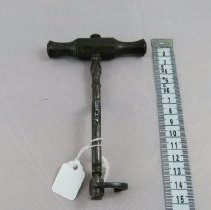
T-shaped with hook |
Dimension Details |
18 X 2 X 10 cm |
Materials |
Ebony/Metal |
Owned By |
J. Andrew Cerswell, D.D.S. |
Donated By |
Doug Beaton, D.D.S., (great nephew-in-law) |
MeSH Search Terms |
Dental Instruments Dentistry Tooth Extraction / Instrumentation |
Classification |
Dental Dental Instruments |
Research Notes |
In an era before modern anaesthesia, a visit to the dentist could be quite a harrowing experience—this device, the toothkey, was used to treat dental issues by extracting the offending tooth. The hook on the end would hook onto a tooth and the dentist would give it a twist to yank it out. Early toothkeys, first used in the 18th century, had a straight shaft, which later gave way to one with a bend in it to avoid cracking nearby teeth when the dentist turned the key. The tooth key is part of a long line of tooth extracting instruments, from the "odontagogon" used by ancient Greek physicians in the 5th century BC to present-day dental forceps. First mentioned in Scottish anatomist’s Alexander Monro’s book Medical Essays and Observations published in 1742, the tooth key was originally designed to mirror the standard door key; on one end lay a large handle, often made from bone, which connected to a hinged iron claw and a bolster by an iron shaft. To complete an extraction, the dental surgeon placed the bolster against the root of the tooth, placed the claw around the crown, and as swiftly as if turning a key in a lock, he successfully dislocated the tooth. |