All Objects Record
Images
Metadata
Object Name |
Amputation Set Case |
Object ID |
2004.119.01.01 |
Date |
About 1865 |
Description |
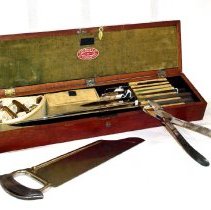
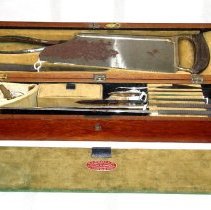
2004.119.01.01: Rectangular wooden box with keylock at front. Three metal hinges. Metal plate for inscription on lid. 2004.119.01.02: Brass screw compression with fabric strap. 2004.119.01.03: Snub nosed saw with cross-latched ebony handle. 2004.119.01.04: Curved pointed metal hook with ebony handle. 2004.119.01.05: Double sided blade with cross-hatched ebony handle. 2004.119.01.06: Serrated knife with ebony handle. handle is cross-hatched. 2004.119.01.07: Single-edged knife with plain ebony handle. 2004.119.01.08: Snub nosed pliers with cross-hatched handles. 2004.119.01.09: Long single-bladed knife with cross hatched ebony handle. 2004.119.01.10: Long single-edged knife with cross-hatched ebony handle. 2004.119.01.11-13: Semi-circular. 2004.119.01.14-18: Straight. 2004.119.01.19-21: Straight with curved end. 2004.119.01.22: Brown paper envelope labelled 1Doz. Needles, assorted. 2004.119.01.30: Brown tissue, 2004.119.01.31: Flat piece of yellow wax with lines through it. 2004.119.01.32: Brown tissue, 2004.119.01.33: Rectangular velvet covered wood with leather flap on top. 2004.119.01.34: Velvet covered wood with leather flap. Tiemann logo attached. Suture needles are both circular and straight. 2004.119.01.02 Petit Tourniquet; 2004.119.01.03 Tenon Amputation Saw; 2004.119.01.04 Tenaculum; 2004.119.01.05 Catlin; 2004.119.01.06 Finger Saw; 2004.119.01.07 Scalpel; 2004.119.01.08 Bone Forceps; 2004.119.01.09 Knife; 2004.119.01.10 Knife; 2004.119.01.11 Suture Needle; 2004.119.01.12 Suture Needle; 2004.119.01.13 Suture Needle; 2004.119.01.14 Suture Needle; 2004.119.01.15 Suture Needle; 2004.119.01.16 Suture Needle; 2004.119.01.17 Suture Needle; 2004.119.01.18 Suture Needle; 2004.119.01.19 Suture Needle; 2004.119.01.20 Suture Needle; 2004.119.01.21 Suture Needle; 2004.119.01.22 Suture Needle Envelope; 2004.119.01.23 Pin; 2004.119.01.24 Pin; 2004.119.01.25 Pin; 2004.119.01.26 Pin; 2004.119.01.27 Pin; 2004.119.01.28 Pin; 2004.119.01.29 Pin; 2004.119.01.30 Tissue Paper; 2004.119.01.31 Suture Wax; 2004.119.01.32 Tissue Paper; 2004.119.01.33 LId; 2004.119.01.34 Tray Separator |
Dimension Details |
2004.119.01.01: 8x41x11, 2004.119.01.02: strap 0.1x74x3, 2004.119.01.03:1.5x27.5x9, 2004.119.01.04: 0.5x16.5x1.5, 2004.119.01.05: 0.75x22x1.5m 2004.119.01.06: 0.75x21x1.5, 2004.119.01.07: 0.5x16x1, 2004.119.01.08: 1.75x19x3.5, 2004.119.01.09: 1x30x1.5, 2004.119.01.10: 1.5x36x1.5, 2004.119.01.11: diameter 5.5, 2004.119.01.12: diameter: 4.7, 2004.119.01.13: diameter 6, 2004.119.01.14: length 3.5, 2004.119.01.15: length 4, 2004.119.01.16: length 3.7, 2004.119.01.17: length 4.4, 2004.119.01.18: length 3.5, 2004.119.01.19: length 6, 2004.119.01.20: length 5, 2004.119.01.21: length 7, 2004.119.01.22: 0.1x8x4.5, 2004.119.01.23: length: 7.3, 2004.119.01.24: length 6.8, 2004.119.01.25: length 4, 2004.119.01.26: length 4, 2004.119.01.27: length 4.1, 2004.119.01.28: length 3.5, 2004.119.01.29: length 3.5, 2004.119.01.30: 0.1x12x4, 2004.119.01.31: 0.5x3.5x3, 2004.119.01.32: 0.1x12x5.5, 2004.119.01.33: 0.5x9.5x3.5, 2004.119.01.34: 1x38.5x8.5 |
Materials |
Wood; Brass; Velvet; Fabric; Leather; Metal; Ebony; Paper; Ink; Wax |
Inscription Type |
Manufacturer's Mark |
Inscription Text |
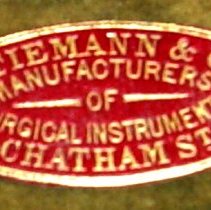
G. Tiemann and Co., Manufacturers of Surgical Instruments, 67 Chatham St., N.Y. USA |
Owned By |
Thompson, Dr. Septimus? |
Donated By |
Thompson, Dr. Charles? |
Provenance |
Septimus Thompson (1876-1956) was born in Strathroy, Ontario, graduated from UWO medical school in 1900, interned at Victoria Hospital, London (1900-01), and then practiced with his brother A.S. Thompson in Strathroy for 2 years. From 1903-06, He took postgraduate training at the Manhattan Eye, Ear, Nose and Throat Hospital, N.Y., and established a specialty practice in London. In 1907 he began teaching ophthalmology and otolaryngology at UWO, and in 1913 was promoted to Associate Professor in these subjects within the Department of Surgery. In 1920, he was promoted to Professor. He retired in 1946 and was awarded an honourary LLD by UWO in 1949. He also was surgeon at Victoria Hospital and St. Joseph's Hospital. Charles Thompson was the son of Septimus Thompson, great- grandson of Dr. Peter Stewart, and Head of Ophthalmology, UWO. |
MeSH Search Terms |
Surgical Procedures, Operative Amputation / Instrumentation |
Classification |
Amputation Amputation, Instrumentation Surgery Surgery, Instrumentation |
Related Publications |
P2004-119a; P2004-119b; P2004-119c Stevenson, Joan. "A Step Back in Time: The Medical Museum." Alumni Gazette 57 (1980): 9-11. Stevenson's article states that one of the surgical kits belonged to Septimus Thompson. |
Research Notes |
Manufactured by George Tiemann and Co., New York, this amputation case contains a tourniquet, several saws and suture materials. This set was probably owned by Dr. Septimus Thompson, grandson of Dr. Peter Stewart and father of Dr. Charles Thompson. Septimus Thompson specialized in opthalmology and otolaryngology, and taught these subjects at Western University in the early 20th Century. Prior to the widespread use of anesthesia and the professionalization of the field in the late 19th century, a successful surgery depended upon a sturdy hand and a sharp knife. Operations lacked precision, were slow, painful, and often dangerous for the patient. Without proper sanitation of the workspace or tools, infection of the wound was often inevitable, resulting in amputation or death. Amputation was particularly rapid on the battlefield, such as in the first world war. New weapons inflicted previously unwitnessed physical destruction on soldiers through shrapnel, while trenches were a prime location to develop malicious conditions due to lack of sanitation. Small wounds quickly developed irreversible and life threatening infections, resulting in the amputation of limb or limbs. As a result of the conditions and circumstances of war, surgical techniques, reconstructive surgery and management of compound fractures all drastically advanced. 2004.119.01.04: for drawing out vessels for tying off after amputation. 2004.119.01.08: for removing pieces of bone that have been amputated. 2004.119.01.31: used to wax sutures. 2004.119.01.32: used to wrap up wax. 2004.119.01.33: covers compartment for needles, pins, and sharpener. 2004.119.01.34: protects instruments in case lid. |